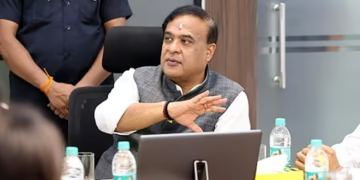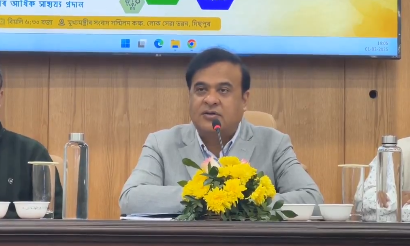

Assam Chief Minister Himanta Biswa Sarma has emphasized the state government’s efforts to enhance skill development and generate livelihoods in the Bodoland Territorial Region (BTR). On Wednesday, he highlighted that these initiatives aim to empower young people and revitalize the local economy.
Through a post on social media platform X, Sarma detailed that Assam has introduced 15 new trades across 22 upgraded training units, significantly improving training standards in the area. In the past four years, 20,097 youths have received training in various sectors, with a goal to train 50,000.
Sarma noted that “Bodoland is accelerating trade, with training and transformation,” adding that the government has certified 4,680 individuals under the Recognition of Prior Learning (RPL) program, enabling them to work as electricians, plumbers, masons, and farmers. Additionally, 1,723 individuals have been trained in piggery, goat and sheep farming, and fish seed cultivation across five districts within the BTR. Over 1,800 youths have also benefited from placement-linked training in fields like tailoring, floriculture, and food services. Furthermore, 75 candidates have acquired skills in heavy vehicle and JCB driving and mechanical operations.
Political analysts view Sarma’s heightened focus on Bodoland as a strategic move ahead of the upcoming Bodoland Territorial Council (BTC) elections, scheduled for September 22. The BJP, which governs alongside its regional partner, the United People’s Party Liberal (UPPL), is eager to solidify its influence in an area where employment and economic self-sufficiency are pressing political concerns.
In his recent discussions, Sarma reiterated the government’s commitment to fostering “peace with progress” in Bodoland. He stated, “The youth of Bodoland are not just beneficiaries of government schemes; they are partners in building a new future. By equipping them with modern skills, we are opening pathways for prosperity and stability.”
As the BTC elections draw nearer, Sarma’s messaging effectively combines developmental statistics with political undertones, positioning the BJP’s governance model as one capable of delivering both stability and opportunities in a region historically affected by ethnic conflict and economic challenges.