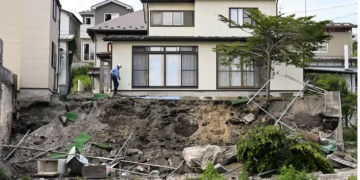
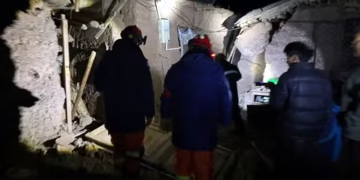
An earthquake measuring 4.3 on the Richter scale struck Nepal in the early hours of Friday, as confirmed by the National Center of Seismology (NCS). According to NCS reports on X, the earthquake occurred at precisely 01:33 AM at a depth of 10 kilometers. Its geographical coordinates were recorded at latitude 29.36 N and longitude 80.44 E. Initial reports indicated that there were no casualties or significant damage from the quake, although further details are still awaited.

Shallow earthquakes like this one tend to be more hazardous than their deeper counterparts, as they release energy closer to the Earth’s surface. This results in stronger ground shaking, which can lead to increased structural damage and higher casualty rates, unlike deeper quakes that dissipate energy as they travel upward.
Nepal is particularly susceptible to seismic activity due to its location at a convergent boundary where the Indian and Eurasian tectonic plates collide. This geological interaction generates considerable pressure, which is ultimately released through earthquakes. Additionally, Nepal is positioned in a subduction zone where the Indian Plate is forced beneath the Eurasian Plate, further contributing to tension within the Earth’s crust.
The Himalayan region, where Nepal is situated, is characterized by intense seismic activity driven by the ongoing collision of these tectonic plates. This continual interaction not only results in earthquakes but also fuels the uplift of the Himalayan mountains, compounding the seismic risks in the area.
Nepal has a history of devastating earthquakes, notably the catastrophic event of 2015 that claimed numerous lives. Recently, a minute’s silence was observed for the 8,969 victims who perished during the 7.8-magnitude earthquake that struck on April 25, 2015. On April 26, Nepali Prime Minister KP Sharma Oli commemorated the disaster while standing beneath a replica of the Dharahara Tower, which collapsed during the quake, resulting in significant loss of life.
This recent seismic activity highlights the ongoing geological challenges faced by Nepal, underscoring the need for continued awareness and preparedness in the face of potential future earthquakes.