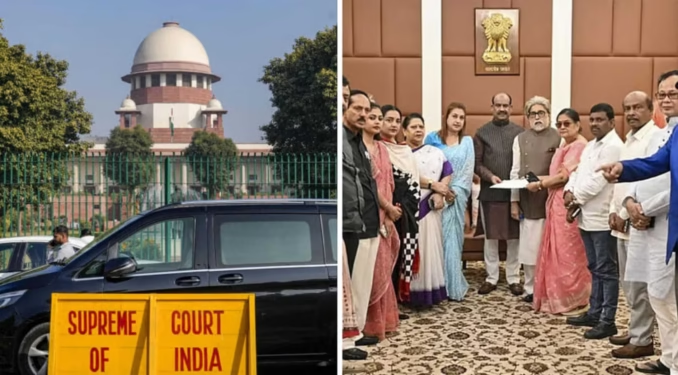
Voting for India’s vice presidential election commenced on Tuesday, September 9, as lawmakers cast their ballots between the ruling BJP alliance’s candidate, Maharashtra Governor C.P. Radhakrishnan, and the opposition INDIA bloc’s nominee, former Supreme Court Justice B. Sudershan Reddy. This election follows the unexpected resignation of Vice President Jagdeep Dhankhar, which made the vote necessary.

Three political parties-Biju Janata Dal (BJD), Bharat Rashtra Samithi (BRS), and Shiromani Akali Dal (SAD)—have announced their decision to abstain from the election. The BJD, led by former Odisha Chief Minister Naveen Patnaik, stated that its MPs would not participate, aligning with its strategy of maintaining “equal distance” from both the BJP-led NDA and the Congress-led INDIA bloc at the national level. The BJD has seven members in the Rajya Sabha but lacks representation in the Lok Sabha.
The BRS, under the leadership of former Telangana Chief Minister K. Chandrashekar Rao, also chose to boycott the vote. Party officials indicated that their abstention is a protest against the ongoing shortage of urea, which has severely impacted farmers in Telangana. BRS working president K.T. Rama Rao highlighted that despite voicing concerns over the past three weeks, neither the central nor the state government responded adequately. He added that had the “None of the Above” (NOTA) option been available, the party would likely have chosen it. The BRS has four MPs in the Rajya Sabha and no representation in the Lok Sabha.
SAD announced its decision to abstain, blaming a lack of support from both the central government and the Punjab government in managing the devastating floods affecting the state. According to the party, nearly one-third of Punjab is inundated, with significant damage to crops and homes, yet no assistance has been forthcoming. SAD leader and former Union Minister Harsimrat Kaur Badal serves as the party’s sole MP in Parliament.
The electoral college for this vice presidential election comprises 788 members, including 245 from the Rajya Sabha and 543 from the Lok Sabha. With seven vacancies, the current total stands at 781, requiring 391 votes for a majority. The NDA holds 422 members, while the INDIA bloc claims about 325 parliamentarians supporting its cause.